
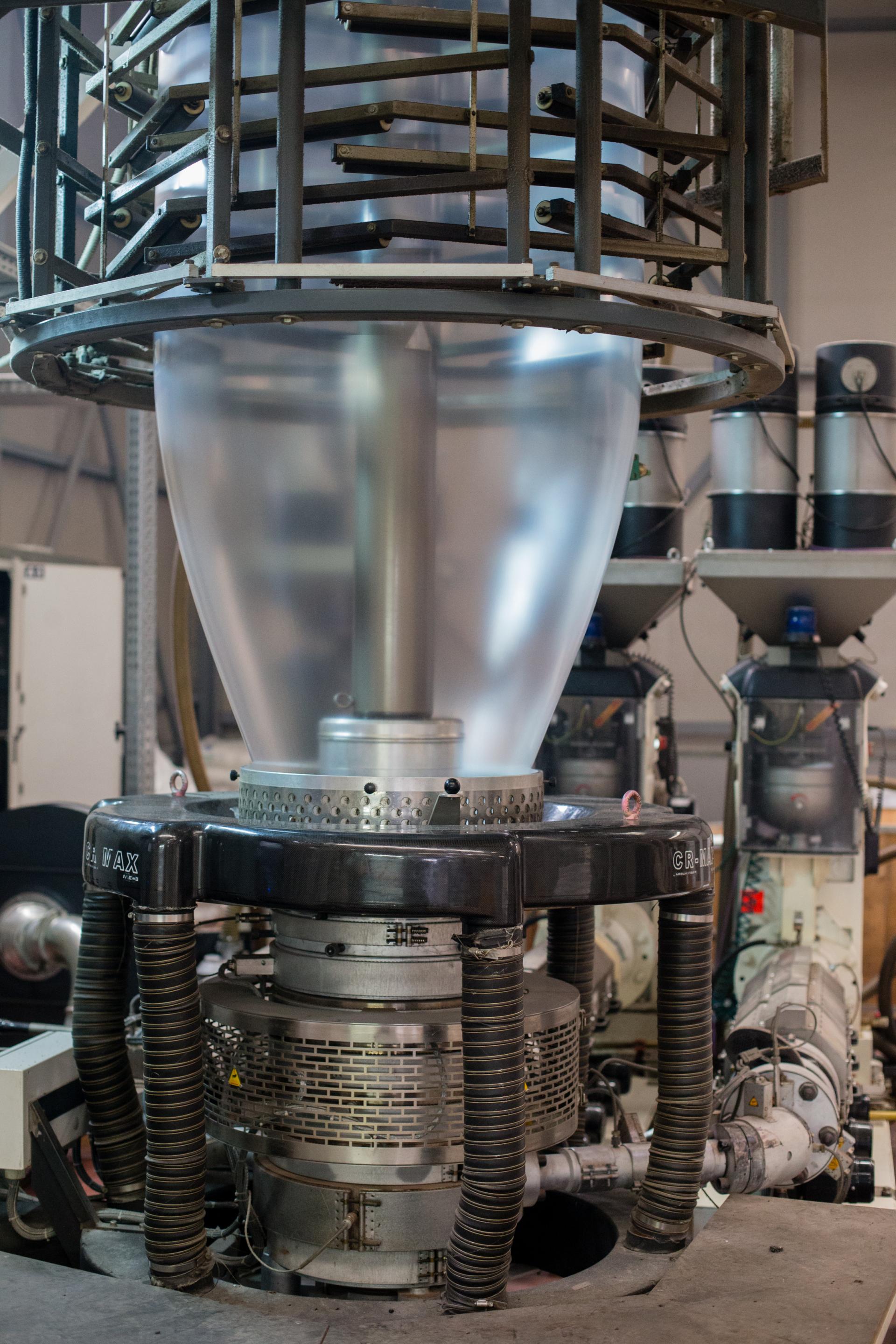
Film Extrusion
Non-Contact Precision for Continuous Extrusion Control.
Overview
Film extrusion (Blown and Cast) is a continuous, 24/7 process where stability is paramount. Roll-2-Roll® Sensors provide non-contact precision to measure and align the web without damaging the delicate product. With no programming needed and a robust design, Roll-2-Roll® Controllers offer a lower total cost of ownership by replacing complex, maintenance-heavy mechanical tracking systems with advanced vision system capabilities.
The Engineering Challenge
Maintaining gauge consistency and dimensional accuracy in extrusion presents unique physical challenges.
- Layflat Variation (Blown Film): In blown film, the "bubble" diameter fluctuates due to air pressure changes. Manual measurement with a tape is dangerous and inaccurate.
- Neck-In Control (Cast Film): As molten plastic leaves the die, it narrows (necks in). Accurately tracking this wandering, molten edge to minimize edge bead trim is difficult for contact or narrow optical sensors.
- Oscillating Haul-Offs: To randomize gauge variations, the haul-off unit oscillates. Web guides must track this movement perfectly; narrow sensors often lose the edge at turnaround points.
The Roll-2-Roll Technical Advantage
Our wide-area sensing technology brings operational simplicity and precision to the extrusion line.
- Wide Viewing Area: With a sensing window up to 960mm, Roll-2-Roll® Sensors track the full range of oscillating webs without needing complex motorized "chaser" bases. This eliminates expensive moving parts.
- Linear Optical Technology: The 1:1 magnification of our fiber-optic array ensures that width measurements keep the same resolution across the entire sensor range, free from the lens distortion common in camera systems.
- 0.0635 mm Resolution: High-precision edge detection and guiding allows for minimal trim waste, directly saving resin costs.
- Non-Contact Safety: One-sided, non-contact measurement keeps operators safe and prevents marking on hot, soft films.
- Modularity: Controllers and sensors are interchangeable; a sensor used for guiding can be repurposed for width measurement.
Key Applications
1. Blown Film Layflat Measurement
In blown film lines, the sensors measure the "layflat" width of the tube to ensure the internal bubble cooling (IBC) and process parameters are correct. This data feeds back to the system via EtherNet/IP or PROFINET for automatic width control, replacing manual measurements.
2. Neck-In & Edge Bead Monitoring
In cast film and extrusion coating, the sensors monitor the "neck-in" (the narrowing of the web) to control the final sheet width. The sensor could identify the transition from the thick edge bead to the flat film, guiding slitters to trim only the necessary amount.
3. Ridge & Structural Feature Detection
The sensors can detect structural features like ridges on extruded plastics (e.g., resealable zippers) or other profile anomalies, ensuring consistent product geometry.
4. Medical & Shrink Tube Extrusion
Single sensors are used for high-resolution width measurement of narrow blown films used for shrink tubes or medical IV bags, where tight dimensional tolerance is critical for downstream performance.
Supported Web Guiding Solutions
Maximize extruder yield with advanced guiding modes tailored for plastic film production.
- Web Oscillation: Critical for blown film. Roll-2-Roll® Controllers can control the oscillation of the haul-off or winder to randomize gauge variations, ensuring flat, high-quality rolls.
- Center Guiding: Maintains the bubble or cast film centerline relative to the machine axis, ensuring even winding and downstream processing.
- Edge Guiding: Used for edge trimming to minimize waste by keeping the web positioned strictly for the slitters.
Technical Comparison
The "Scanner vs. Laser Pointer" Analogy: Comparing an Roll-2-Roll® Sensor to a standard fork style sensor is like comparing a flatbed scanner to a laser pointer. While a laser pointer sensor might lose a wandering web, the Roll-2-Roll® Sensor (scanner) sees the entire oscillation path, maintaining a lock on the web edge regardless of lateral movement or neck-in variations.
- Oscillation Tracking: Competitors use motorized "Chaser" slides (mechanical wear). Roll-2-Roll Technologies uses Wide Sensor Array (Solid state, no moving parts).
- Measurement: Manual tape measure is unsafe. Roll-2-Roll® Sensors offers Automated Real-Time Feedback.
- Edge Bead: Low-res sensors miss the transition. Roll-2-Roll® Sensor's 0.0635 mm Resolution saves resin.
- Simplicity: Vision systems are complex. Roll-2-Roll® Sensor is Plug-and-Play.