
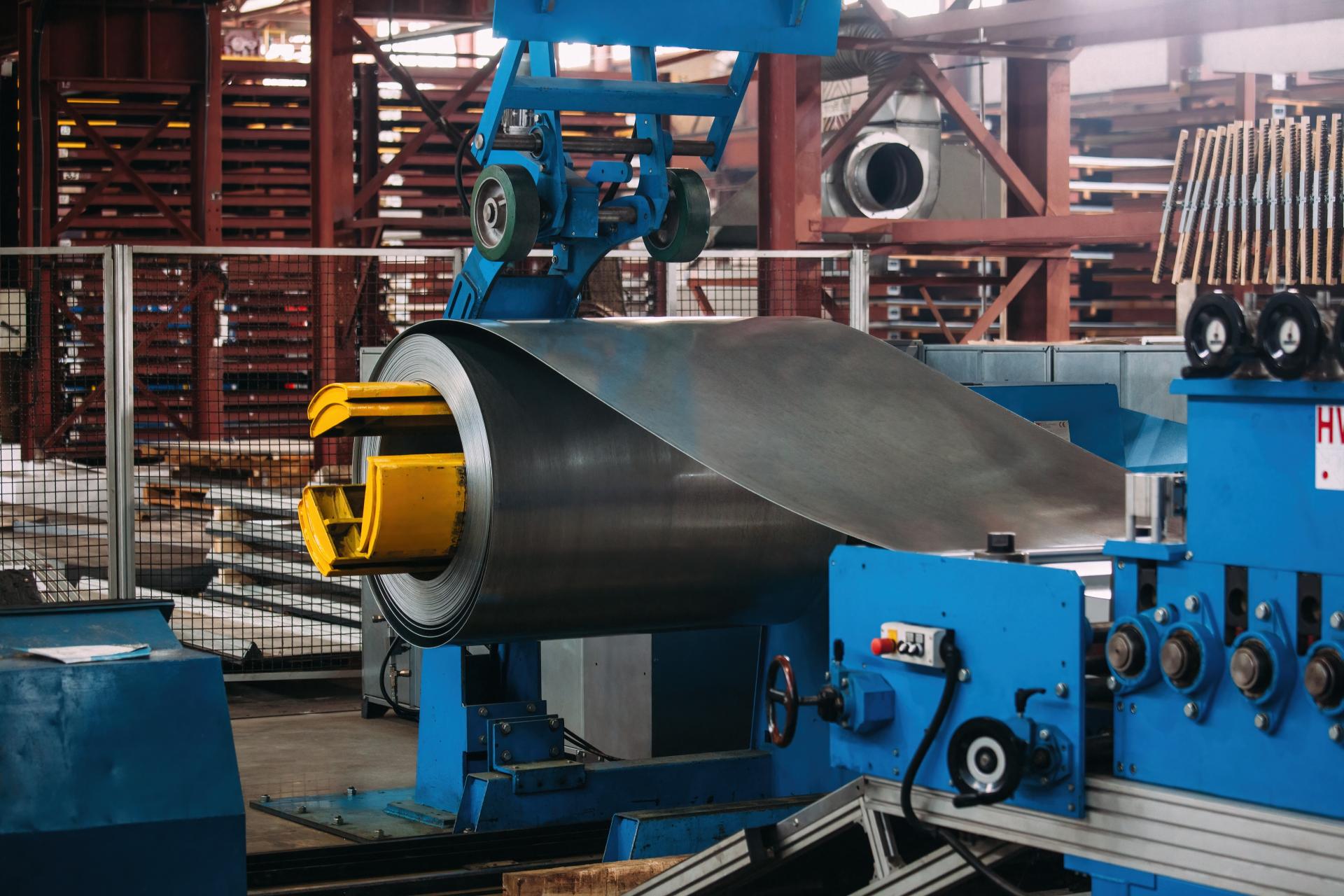
Metal Processing
Robust Control for Heavy Industry: Handling Camber and Reflection with Ease.
Overview
Coil coating, steel, and aluminum processing involve heavy, rigid webs in harsh environments defined by oil, vibration, and impact. Roll-2-Roll delivers robust sensing capable of managing the extreme physical characteristics of metal strips. With environmental robustness and a Vision System in a Sensor Package design, our sensors reduce maintenance and downtime while fitting where bulky C-frames cannot.
The Engineering Challenge
Metal processing combines heavy mechanical forces with difficult optical properties.
- Camber: Metal strips often have a "banana" curve. This creates immense lateral forces. Measuring this camber in real-time is crucial for steering the uncoiler.
- Reflection (Glare): Polished metals reflect light like a mirror (specular reflection), blinding standard optical sensors that rely on diffuse reflection.
- Physical Durability: Sensors must withstand accidental impact from heavy strips and operate in oily environments.
The Roll-2-Roll Technical Advantage
We combine rugged hardware with smart optical filtering and installation advantages.
- Reflective Surface Handling: Roll-2-Roll's Spatial Filtering technology manages specular reflection effectively. It ignores the glare and locks onto the scattering from the edge, ensuring stable guiding on polished aluminum or steel.
- Abrasive Environment Ready: Because the sensor uses 1:1 optical magnification and advanced algorithms, it can be mounted further away from the web (up to 3 inches in some cases) to avoid damage from abrasive metal strips or web flutter.
- Wide Sensor Range: With sensor widths up to 960 mm, the system can measure strip curvature (camber) continuously without mechanical tracking or motorized positioners.
- One-Sided Mounting: In vertical accumulators or annealing lines where two-sided frames are impossible to mount, the Roll-2-Roll one-sided sensor mounts easily to the machine frame.
Key Applications
1. Camber Detection
Using wide-range sensors to measure the strip curvature (camber) continuously. This data drives the uncoiler to pivot and compensate, preventing telescoping rolls and side-wall damage.
2. Vacuum Coating Operations
Roll-2-Roll® sensors are robust enough to operate inside vacuum chambers, making them ideal for metal coating or metallizing processes where standard sensors fail. Ideally suited for accumulator & annealing lines.
3. Strip Width Measurement
Used for measuring the width of metal strips during converting or manufacturing. The Linear Optical Technology provides distortion-free imaging for repeatable validation of the final product width.
Supported Web Guiding Solutions
Heavy-duty control for high-tension metal processing.
- Center Guiding: The preferred method for coil processing. Two sensors track the strip edges to keep the coil centered entering the furnace or coating head, regardless of width variations.
- Unwind & Rewind Guiding: Hydraulically or electromechanically shifts the heavy uncoiler/recoiler to ensure the strip feeds straight and winds perfectly, preventing telescoped coils.
- Edge Guiding: Used for edge trimming operations where the strip must be positioned precisely relative to the knives to minimize scrap.
Technical Comparison
The "Scanner vs. Laser Pointer" Analogy: Comparing an Roll-2-Roll Sensor to a standard photo-eye is like comparing a flatbed scanner to a laser pointer. Glare from polished metal blinds a standard photo-eye (laser pointer) like a mirror reflecting into your eye. The Roll-2-Roll sensor (scanner) uses spatial filtering to "see through" the glare, focusing only on the scattered light from the physical edge of the strip.
- Glare: Blinds standard optics. Roll-2-Roll uses Spatial Filtering to ignore specular reflection.
- Mounting: Requires heavy C-frames. Roll-2-Roll uses One-Sided Beam Mounting.
- Camber: Difficult to track with narrow sensors. Roll-2-Roll's Wide Sensor tracks full movement.
- Durability: Standard sensors are fragile. Roll-2-Roll is built for Harsh Environments.