
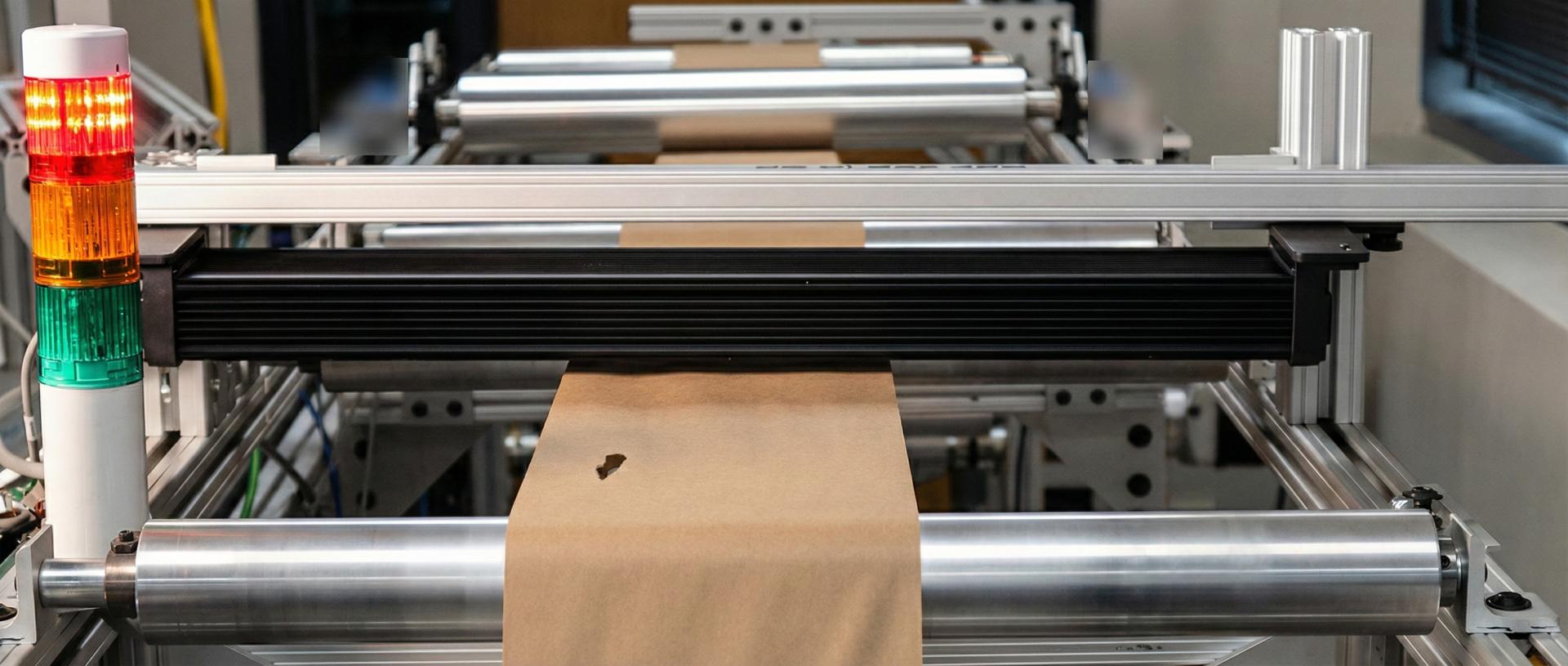
Surface Defect Detection
Surface defect detection identifies holes, tears, voids, contamination, and other quality issues on moving webs in real time. Roll-2-Roll Technologies provides high-resolution sensors that detect holes, tears and voids as small as 0.25 mm across the web—preventing defective material from reaching customers and enabling immediate process corrections. Detection along the web depends on line speed and scan rate. Unlike manual inspection or end-of-line quality checks, our sensors scan the full web width continuously, catching defects the moment they occur.
The Challenge: Defects Discovered Too Late
Traditional quality control methods create costly delays and customer rejections:
- End-of-Line Inspection: Manual inspection after winding means defective material has already been produced—requiring expensive rework or scrap.
- Sample-Based QC: Inspecting only samples (e.g., every 10th roll) allows defective rolls to ship undetected.
- Operator Fatigue: Human inspectors miss defects during long shifts, especially on high-speed lines or repetitive patterns.
- No Process Feedback: Without real-time defect detection, operators cannot correlate defects with process parameters to identify root causes.
The Solution: Automated Full-Width Web Inspection
Roll-2-Roll defect detection sensors scan the full width of the web continuously, identifying defects in real time and triggering automatic responses.
How It Works
- Full-Width Scanning: Line scan sensors with viewing areas up to 960mm inspect the full width of the web on every scan
- Defect Detection: Holes, tears, and voids are detected as edges or gaps in the 1D profile
- Automatic Actions: When defects are detected, the system can trigger alarms, reject mechanisms, or stop the line
Key Advantage: Real-time detection enables immediate process corrections—preventing continuous production of defective material that traditional end-of-line inspection cannot stop.
Key Benefits
- Full-Width Inspection: The entire web width is scanned continuously—no sampling, no gaps
- Real-Time Process Feedback: Defects detected instantly, allowing operators to correct process parameters immediately
- Prevent Customer Rejections: Defective material is identified and removed before shipping
- Data-Driven Quality Improvement: Defect logs enable root cause analysis and continuous improvement
- Eliminate Operator Fatigue: Automated inspection provides consistent quality monitoring regardless of shift length
Applications by Industry
- Battery Manufacturing — Detect holes, tears, and coating voids in electrode films that create cell safety hazards.
- Nonwovens & Hygiene — Identify tears and holes in diaper topsheets and backsheets before assembly.
- Flexible Packaging — Detect pinholes and contamination in barrier films that compromise package integrity.
- Medical Device Manufacturing — Ensure defect-free materials enter sterile packaging lines.
- Film Extrusion — Detect holes, tears, and voids in real time during production.
Related Solutions
- Splice Detection — Detect splices and joints
- Flag Detection — Identify defect flags and markers
- Edge Detection — Monitor web position