
Flexible Printed Electronics
High-Resolution Registration at Production Speed.
Overview
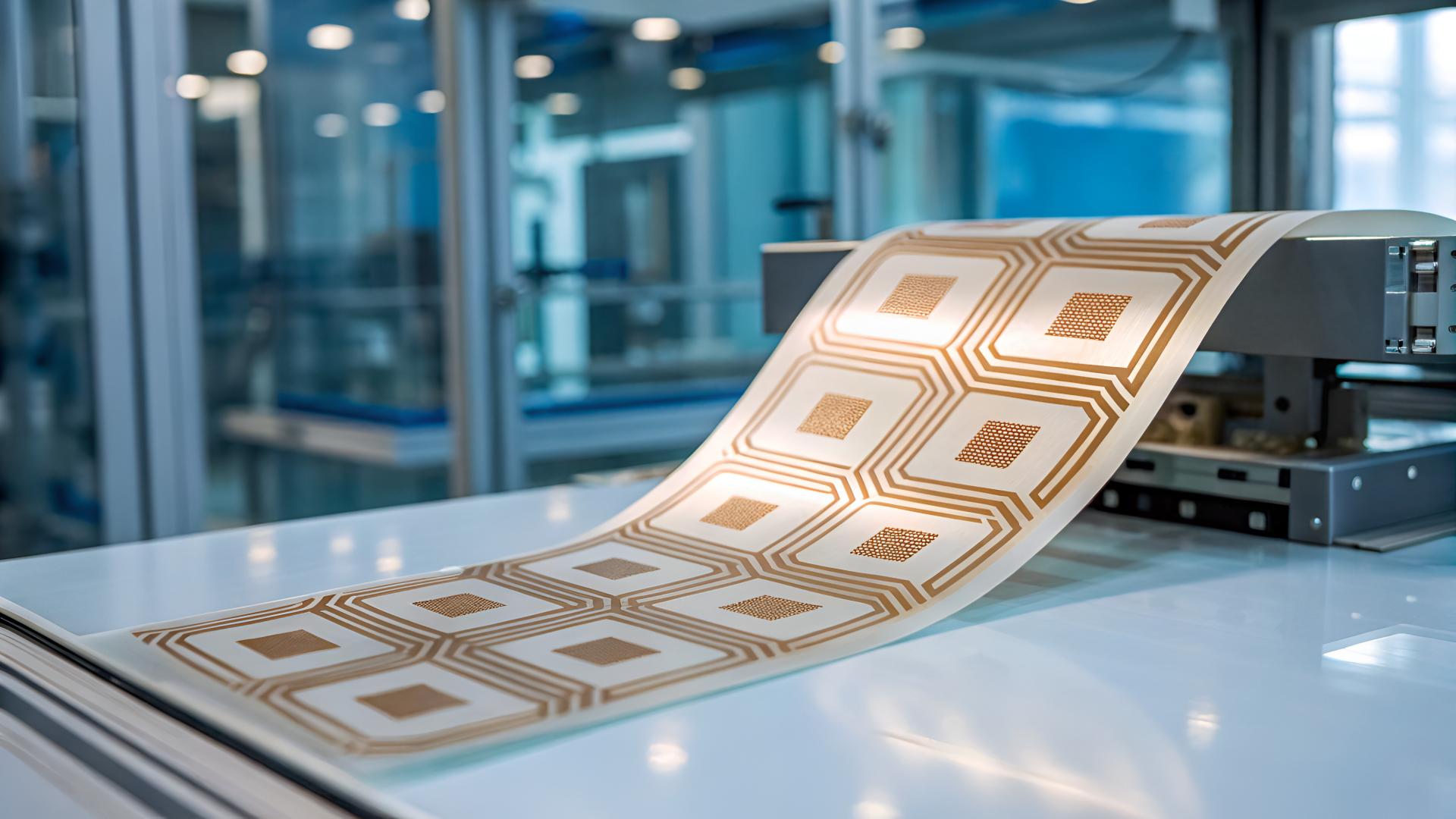
Printing circuits (RFID, OLED, Solar) on flexible substrates combines the throughput of roll-to-roll manufacturing with the precision of semiconductor fabrication. Roll-2-Roll provides a Vision System in a Sensor Package, delivering 0.0635 mm resolution and ±0.127 mm repeatability for multi-layer registration without the complexity of traditional camera systems. Our sub-pixel approximation technology enables a firmware resolution of 0.016 mm, ensuring perfect alignment of conductive traces and dielectric layers.
The Engineering Challenge
Electronic functionality depends on perfect physical alignment in challenging environments.
- Registration Accuracy: Printing multiple conductive layers requires micron-level overlay accuracy. A slight misalignment breaks the circuit or reduces device performance.
- Vacuum Environments: Many processes (like sputtering or deposition) happen in a vacuum where pneumatic and ultrasonic sensors fail due to lack of air or sound propagation.
- Delicate Substrates: Materials like PET or PEN are thin and easily scratched, requiring non-contact sensing.
The Roll-2-Roll Technical Advantage
We bring lab-quality measurement to the production floor with operational simplicity.
- 0.016 mm Firmware Resolution: Our sub-pixel approximation technology provides the extreme resolution necessary to align conductive traces and dielectric layers, far exceeding standard photo-eyes.
- Vacuum Compatibility: Fiber optics inherently work in vacuums. The sensor operates inside deposition chambers.
- Fiducial Tracking: High-speed tracking of printed marks ensures layer-to-layer registration is maintained dynamically.
- Linear Optical Technology: Unlike traditional cameras with circular lenses that cause distortion, our patented fiber-optic array provides 1:1 image magnification. This ensures measurement resolution is not affected by the sensor's field of view.
- No Programming Needed: Unlike complex vision systems that require an expert to maintain, Roll-2-Roll systems are designed to be parameterized and operated by standard line operators.
Key Applications
1. Multilayer Registration
Track fiducial marks to align print layers with sub-pixel firmware resolution. Roll-2-Roll sensors ensure that conductive inks, insulators, and active layers stack perfectly to create functional devices.
2. Flat Ribbon Cable Slitting
Used for slitting and quality control of flat ribbon cables. The sensor ensures precise width measurement of the insulated cables, verifying that conductors are properly spaced and the insulation width is within tolerance.
3. Printed Line Guiding
The system can guide the web based on a printed line or conductive trace rather than the physical edge of the web. This is critical for printed electronic circuits where the functional component must be aligned regardless of web edge variations.
4. Vacuum Deposition Guiding
Guide webs inside vacuum chambers for solar or OLED production. Roll-2-Roll sensors are vacuum compatible and operate directly inside the chamber.
5. Conductive Trace Inspection
Detect "opens" (breaks) in printed lines. Using the high-resolution camera capabilities, the sensor can verify the continuity of printed traces in real-time, flagging defects immediately.
Supported Web Guiding Solutions
Micron-level control for functional electronics.
- Line & Contrast Guiding: The primary mode for printed electronics. Tracks fiducial marks or printed conductive lines to keep layer-to-layer registration repeatable.
- Master-Slave Guiding: Essential for multi-layer lamination (e.g., encapsulation). The cover sheet (slave) follows the exact position of the active substrate (master) to prevent exposure.
- Center Guiding: Keeps delicate substrates (PET/PEN) centered in vacuum chambers or coating zones to prevent edge damage and ensure uniform deposition.
Technical Comparison
The "Scanner vs. Laser Pointer" Analogy: Comparing an Roll-2-Roll Sensor to a standard photo-eye is like comparing a flatbed scanner to a laser pointer. A laser pointer is too crude to see a fiducial mark as small as 0.25 mm. The Roll-2-Roll Sensor (scanner) sees the entire "picture" of the web's edge and features, identifying the exact position of tiny registration marks with sub-pixel precision to align layers perfectly, all while remaining as easy to use as a standard office appliance.
- Precision: Standard sensors are ±0.1mm. Roll-2-Roll delivers 0.016 mm (16 µm) firmware resolution.
- Environment: Roll-2-Roll® Sensors are vacuum compatible and detect clear films inside vacuum chambers, where ultrasonic sensors can't work.
- Registration: Basic edge guiding isn't enough. Roll-2-Roll tracks Fiducials & Features.
- Simplicity: Vision systems need coding. Roll-2-Roll needs No Programming.