
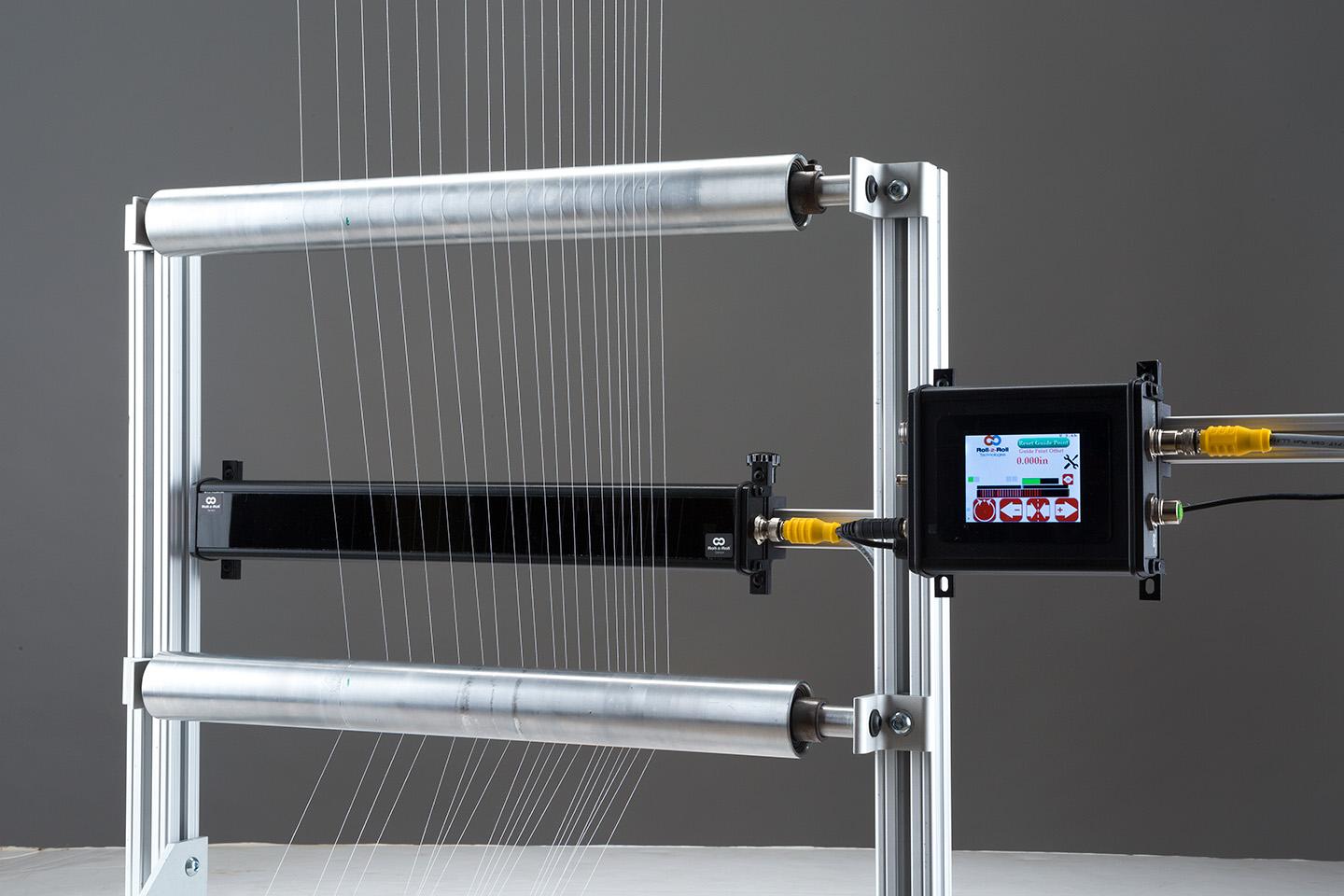
Thread Counting
Thread counting monitors individual threads, strings, or narrow webs as they move through textile, composite, and converting machinery. Roll-2-Roll Technologies provides high-resolution line scan sensors that count threads with statistical precision, measuring individual widths, spacing, and detecting missing threads in real time. Unlike mechanical counters or photo-eyes that provide only binary counts, our sensors deliver rich data analytics—width distributions, gap measurements, and quality metrics—essential for maintaining consistent textile and composite production.
The Challenge: Manual Thread Counting and Quality Blind Spots
Traditional thread monitoring creates operational inefficiencies and quality risks:
- Manual Counting: Operators manually count threads during setup—time-consuming, error-prone, and impossible to verify continuously during production.
- Binary Counters: Photo-eye counters detect "thread present/absent" but cannot measure thread width, spacing uniformity, or detect partial breaks.
- No Statistical Data: Without width and spacing measurements, manufacturers cannot detect process drift or predict quality failures.
- Missing Thread Detection: By the time a missing thread is noticed, significant off-spec material has already been produced.
The Solution: High-Resolution Thread Monitoring with Statistical Analysis
Roll-2-Roll thread counting sensors use line scan camera technology to create a one-dimensional image of the thread array, measuring each thread individually.
How It Works
- Line Scan Imaging: The sensor captures a 1D image across the thread array
- Individual Thread Detection: Advanced algorithms identify each thread edge and measure its width
- Gap Analysis: The system measures spacing between threads
- Statistical Output: Real-time statistics on thread count, average width, width distribution, and gap uniformity
Key Advantage: A single wide-area sensor (up to 960mm) monitors dozens of threads simultaneously, providing complete coverage without multiple individual sensors.
Key Benefits
- Automated Thread Counting: Eliminates manual counting during setup and changeovers
- Width & Spacing Measurement: Detects when individual threads are too wide, too narrow, or unevenly spaced
- Missing Thread Detection: Instantly alerts operators to broken or missing threads before significant waste
- Statistical Process Control: Width distribution data enables predictive quality management
- Multi-Thread Monitoring: One sensor tracks 5+ threads, strips, or narrow webs simultaneously
Applications by Industry
- Carbon Fiber Manufacturing — Count and measure individual tow widths during spreading. Detect gaps that reduce structural integrity.
- Textiles & Weaving — Monitor warp thread count and spacing. Detect broken threads in high-speed looms.
- Narrow Web Slitting — Measure multiple slit lanes simultaneously. Verify all strips are present and within tolerance.
- Tape Manufacturing — Count parallel adhesive strips. Measure width consistency across multiple lanes.
- Composite Layup — Monitor fiber tow placement. Ensure no gaps or overlaps in automated layup systems.
Related Solutions
- Web Width Measurement — Continuous width monitoring
- Edge Detection — High-precision position measurement
- Defect Detection — Detect tears, voids, and surface defects