
Displacement Web Guides: Principles and Applications
In this episode of the webinar series 'Web Guiding Fundamentals,' we delve into the intricacies of displacement web guides, a widely used and recommended solution for web guiding applications. Learn how these guides work without bending the web, their design principles, and why they are considered 'perfect web guides' with a one-to-one ratio of movement. Discover the importance of entry and exit roller alignment, and understand the difference between displacement and offset pivot guides.
00:00 Introduction to Intermediate Web Guides
00:02 Understanding Displacement Web Guides
00:17 Mechanics of Displacement Web Guides
01:08 Design Principles and Benefits
01:26 Addressing Common Questions
01:59 Importance of Twist in Web Guides
Transcript
Show full transcript (343 words)
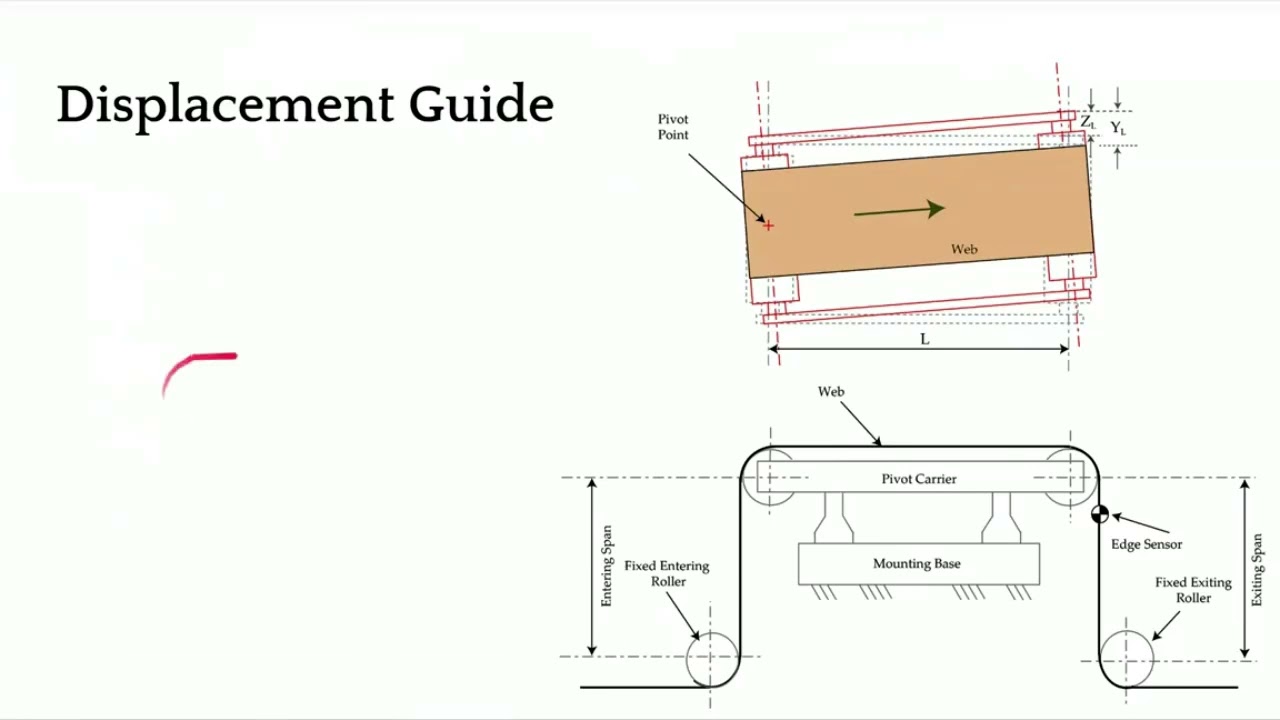
Now moving over to intermediate web guides, we have a displacement web guide. This is another type of one of the most commonly used web guide that you're going to see and we would recommend this as the first choice for any web guiding application. One of the main reasons for that is it actually displaces the web. And in this web guide, it's not bending the web.
The reason why it's not bending the web is you have this entry span and a 90° wrap. And then you have the plane of the carriage right here. When this carriage pivots, the pivot point is shown here, but that's a mistake. It should have been right at the edge of right here.
So when this carriage rotates, pivots about the pivot point at this point right there, these two rollers are actually moving in tandem. So there's no bending in this region. In these fans, since they are perpendicular, that motion is a pure twist. So really there is no bending in this kind of a web guide.
If the web guide is designed properly, then these web guides can have one one ratio in the sense that if you move the web guide one unit, then the web will actually move one unit. That's why we call them a perfect web guide. I do see a question here that says, would you agree that an offset pivot guide acts on a different principle other than normal entry? That is correct.
Because these two rollers are parallel to each other. There is no bending in the span. The entry and the exit rollers are perpendicular or the wrap angle are perpendicular. This span is perpendicular to the plane of motion of the web guide.
They are going to be in twist. So there's no bending. And when there's no bending, there's no normal entry coming into picture there. The twist is an important design part.
And this would be our first choice for us in terms of applying it in any webg guiding situation.