
Center Guiding Systems
Perfect Symmetry. Automatic Width Tracking. No Moving Sensors.
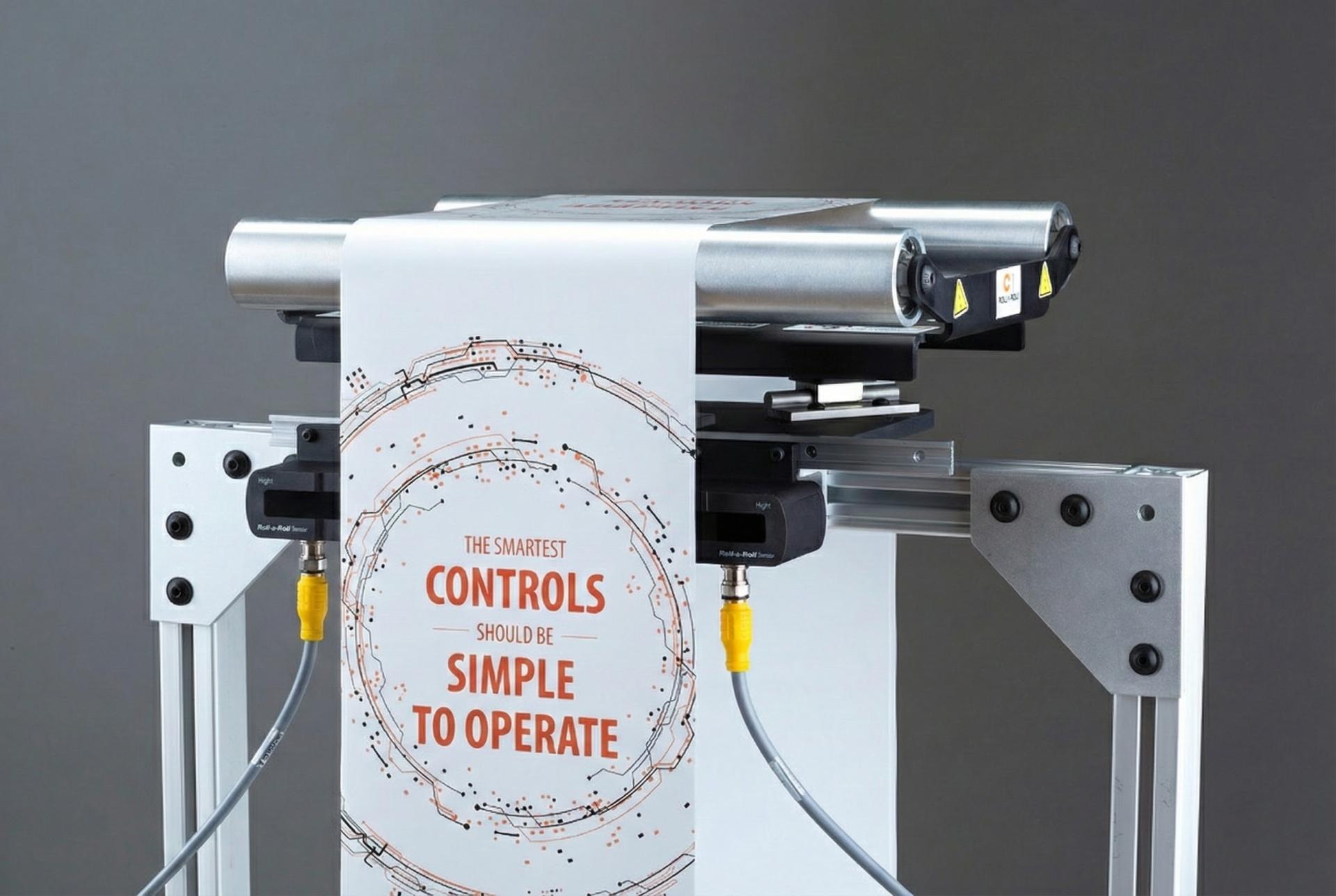
Center guiding is the process of aligning the centerline of a moving web to the centerline of the machine process. While traditional systems require motorized lead screws (sensor positioners) to physically move sensors whenever the web width changes, Roll-2-Roll® Sensors are wide thereby eliminating the need for sensor repositioning. Roll-2-Roll® Sensors have a large field of view (up to 960mm), allowing them to track significant width variations electronically. This eliminates the need for mechanical sensor adjustments, reduces maintenance, and provides automatic centerline tracking for clear films, nonwovens, and opaque materials without recalibration.
The Challenge: The Complexity of "The Old Way"
For decades, center guiding has been mechanically complex and maintenance-heavy. Because legacy sensors have a narrow viewing range (often just ±10mm), they cannot see the web edge if the product width changes significantly.
To solve this, legacy systems use Sensor Positioners—motorized mechanical assemblies that physically move the sensors in and out to "chase" the web edges,.
- High Failure Rates: Sensor positioners introduce motors, lead screws, and sliding brackets that jam, wear out, and require lubrication.
- Control Instability: These systems require two fighting control loops: one loop to guide the web and a second loop to chase the edges. This can cause "hunting" and oscillation.
- Slow Changeovers: Operators must wait for the motors to reposition sensors for new product runs, increasing downtime.
The Solution: The Roll-2-Roll "Simplicity" Way
We replaced mechanical complexity with optical intelligence. By using Wide Sensing Range, we cover the entire range of potential web widths with a static, solid-state device.
Why Roll-2-Roll Center Guiding is Different:
- No Moving Sensors: Our sensors feature sensing windows ranging from 48mm to 960mm. They stay fixed to the machine frame while the software tracks the edges and calculates the centerline mathematically.
- Inherent Error Reduction: The system averages the position of the left and right edges. This naturally filters out edge defects, fuzzy nonwoven edges, and minor flutter, resulting in a significantly more stable web than single-edge guiding.
- Wrinkle Immunity: Wrinkles effectively narrow the web width. Single-edge sensors interpret this as a position error and move the guide unnecessarily. Center guiding sees the width reduction on both sides, calculates the true center, and ignores the wrinkle effect.
Available Width Coverage
Two ODC 960 sensors handle a width change of up to 1,900 mm (75 in). Because head spacing sets the nominal width, there is no fixed maximum web width. Even at this unprecedented width range, the sensors maintain 0.127 mm resolution, enabling repeatable center guiding on webs from narrow labels to wide industrial films.
For applications requiring wide coverage, the ODC 480, ODC 768, and ODC 960 provide large sensing windows, eliminating the need for expensive custom solutions.
| Feature | Legacy Mechanical Sensor Positioners (Old Way) | Wide Roll-2-Roll® Sensor (New Way) |
| Width Changeovers | Wait for motors to move sensors | Instant (Zero downtime) |
| Maintenance | High (Lubrication, lead screws, belts) | Zero (Solid state optics) |
| Control Logic | Complex "Chasing" loops | Simple Centerline Math |
| Edge Quality | Jitters on fuzzy edges | Averages out defects |
Engineering Guide: Sizing Your Sensor Field of View
One of the most common questions from engineers is: "Which sensor size do I need to handle my web width variations without moving the sensors?"
Because Roll-2-Roll® Sensors are fixed in place, the Sensor Range (Field of View) must be large enough to see the web edge at both its widest and narrowest states, plus room for the web to wander.
The Selection Formula
To select the correct sensor, perform the following calculation:
- Determine Total Width Change: Calculate the difference between your widest product and your narrowest product. $$\Delta W = W_{max} - W_{min}$$
- Calculate Change Per Side: Since the web shrinks or grows equally from the center, each sensor only needs to cover half the total change. $$\text{Range Needed per Edge} = \frac{\Delta W}{2}$$
- Add the "Wander Delta": The web will never be perfectly centered entering the guide. You must add a safety margin (Delta) to account for upstream web wander (typically ±10mm to ±25mm depending on the process). $$\text{Total Sensor Field of View (FOV) = Range Needed per Edge + Wander Delta}$$
- Round Up to Nearest Sensor Size: Select the Roll-2-Roll® Sensor with a Sensing Window larger than your Total FOV.
Calculation Example
- Max Web Width: 500 mm
- Min Web Width: 400 mm
Expected Wander: ± 15 mm
$$\text{Total Change} = 500 − 400 = 100 \text{mm}$$
$$\text{Change Per Side} = \frac{100}{2} = 50 \text{mm}$$
$$\text{Required FOV} = 50 \text{mm} + 15 \text{mm (Wander)} = 65 \text{mm}$$
Selection: The ODC 96 (96mm window) is the correct choice, as the ODC 48 (48mm) would be too small.
System Configurations (Select Your Kit)
Wide-Web Center Guide Kit (Split Sensors)
Best for: Converting lines where width varies significantly.
- Sensors: 2 x Roll-2-Roll® Sensors (e.g., ODC 192 or ODC 384) mounted on fixed brackets.
- Controller: SCU6x or SCU5(Calculates centerline and width).
- Benefit: Cost-effective for wide webs; eliminates the need for a cross-machine sensor bar.
Narrow-Web Center Guide Kit (Single Sensor)
Best for: Label converting, battery electrode, and narrow web applications.
- Sensor: 1x ODC 480 (480 mm), ODC 768 (768 mm), or ODC 960 (Single unit spans the full web).
- Benefit: Easiest installation. No alignment required between two separate sensors. Ideal for space-constrained machines.
Technical Specifications (Roll-2-Roll® Sensors)
One sensor family for any material—Clear, Opaque, Reflective, Nonwoven, or Mesh.
| Sensor Model | Sensing Window (FOV) | Best Application |
| ODC 48 | 48 mm | Fixed width webs with minor wander |
| ODC 96 | 96 mm | Moderate width changes (e.g., 2-3 inch variance) |
| ODC 192 | 192 mm | Large width changes or narrow web full-coverage |
| ODC 384 | 384 mm | Large width changes or narrow web full-coverage |
| ODC 480 | 480 mm | Full coverage for narrow webs + large width changes |
| ODC 768 | 768 mm | Full coverage for mid webs (no dead zones) + large width changes |
| ODC 960 | 960 mm | Full coverage for mid webs (no dead zones) + large width changes |
The Hidden Cost of Moving Sensor Systems
Traditional center guiding with mechanical sensor positioners creates costly delays and risks that accumulate over time:
Width Change Delays
When web width changes on-the-fly, moving sensor systems must pause guiding while motors reposition the sensors to the new edge locations. This creates a control gap where the web is unguided, leading to misalignment and potential waste. With Roll-2-Roll® Sensors, width changes are handled electronically in milliseconds—no repositioning delay, no loss of control.
Fork Sensor Collision Risk
Legacy fork-style sensors present a physical obstruction. When web width increases unexpectedly (material variation, tension changes, or process adjustments), the expanding web can contact the sensor fork, causing:
- Web damage: Scratches, tears, or contamination from sensor contact
- Sensor damage: Impact can misalign or break the fork assembly
- Line stops: Emergency shutdown to prevent further damage
- Waste: Material run during the collision must be scrapped
The Roll-2-Roll Advantage: Wide one-sided Roll-2-Roll® Sensors are mounted outside the web path. Even when web width increases dramatically, there is no physical sensor in the way—eliminating collision risk entirely.
Multiple Control Loops = Complexity
Moving sensor center guides require two competing control loops: one loop guides the web to centerline, while a second loop chases the edges with mechanical positioners. This dual-loop architecture introduces:
- Tuning complexity (two PID loops must be balanced)
- "Hunting" behavior (loops fight each other)
- Increased commissioning time
- Specialist knowledge required for troubleshooting
Roll-2-Roll systems use a single control loop—the sensor images both edges, the controller calculates the centerline, and the guide steers the web. No mechanical chasing, no fighting loops, no specialist setup.
Cost Comparison: Capital + Hidden Costs
| Cost Category | Moving Sensor System | Roll-2-Roll® Sensor |
|---|---|---|
| Capital Equipment | Sensors + Positioners + Extra motors | Sensors only (no positioners) |
| Maintenance | Lead screws, belts, motors, lubrication | Zero moving parts |
| Downtime (width changes) | Wait for repositioning (seconds to minutes per change) | Instant electronic adjustment |
| Spare Parts Inventory | Positioner motors, lead screws, brackets | None (solid-state optics) |
| Commissioning Time | Complex (tune two control loops) | Simple (one control loop) |
For converters running short production runs with frequent width changes, the cumulative cost of repositioning delays can exceed the capital cost difference within months.
ROI & Results
Eliminate Mechanical Wear. By removing the mechanical sensor positioners found in legacy systems, you eliminate a major category of spare parts and maintenance tasks.
- 100% Reduction in sensor movement downtime.
- Free Width Measurement: Get continuous quality data without buying a separate camera system.
- Safety: Operators never need to reach into the machine to adjust sensors for different product widths.