
This video delves into the necessity of web guiding, covering key reasons such as material imperfections, machine variations, tension control issues, and operator errors. It explains the significance of web guides at different machine locations, differentiating between intermediate and terminal guides, and uses lamination as an example to illustrate the need for precise web alignment. Join us as we explore why and where web guides are essential in the roll-to-roll process.
00:00 Introduction to Web Guiding
00:07 Reasons for Web Guiding
00:11 Material Imperfections
01:02 Machine-Related Issues
01:37 Process-Related Issues
02:02 Operator Errors
02:17 Types of Web Guides
03:02 Conclusion
Transcript
Show full transcript (519 words)
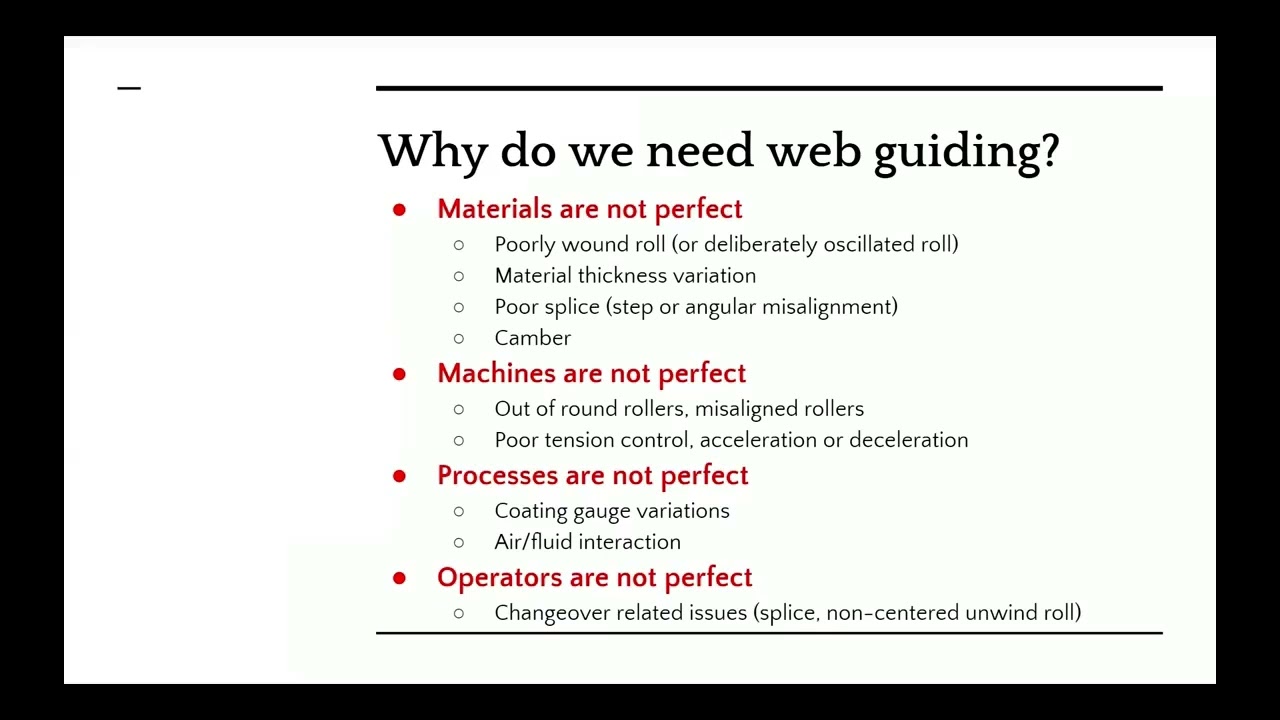
[Music] So why do we need web guiding? Well, there are mainly four reasons why we need web guiding. First and foremost is that materials are not perfect. You might have a poorly wound roll that is not wound properly or deliberately wound roll with an oscillation on it.
And when you are trying to feed it into your rollto-roll machine, you need to guide it so that it aligns with your process. Some materials may have thickness variation like gauge band variation either during coating or forming processes especially with paper mills. Different gauge papers may track or slide differently. Splices when joining two rolls of web might be a step change or an angular misalignment.
Some materials have a natural curvature called camber. So when the materials are not perfect, that's going to have the web nist track in your machine. It could also be due to machine itself. So either you have machines with out of round rollers like a crown concave or a convexed roller.
Whenever you have a variation in the diameter of the roller, that's a problem. Or the rollers are not aligned properly with respect to each other. That could also cause the webs to misrack. You might also have tension control issues.
If you don't have enough tension, you don't have traction, then that's going to be an issue. Whenever you have acceleration or deceleration, that might also cause the web to misrack. It could also be due to processes. For example, if you have a coding process and you have uneven coding across the width of the web, that's going to cause issues with tracking.
And also some processes where you could have air intrained between the web and the roller that would cause the web to lose fraction and mistract. That could also be an issue. That's why we need web guiding. Finally, operators mainly when they are splicing the web or when they are putting a new parent roll into their roll-to-roll machine, they may not center it or put it at the right location.
That might also cause an issue and might need web guiding. So web guides are necessary at different locations of the machine because you might need alignment at different parts of the machine. That's the main thing with web guiding. You have to put a web guide in front of any process that requires web alignment.
Just to give you an example, let's say you are laminating something and you have two layers of web coming in to this lamination process. At this point you would need a web guide so that you can align this layer and this layer with respect to each other. The guides that are used within the machine are called intermediate guides or they are intermediate to the machine and the guides that are used at the entry and exit of the machines are called as terminal guides. So we're going to look at all of these in detail but that gives you an idea of why we need web guides and where we need web guides.
[Music]